
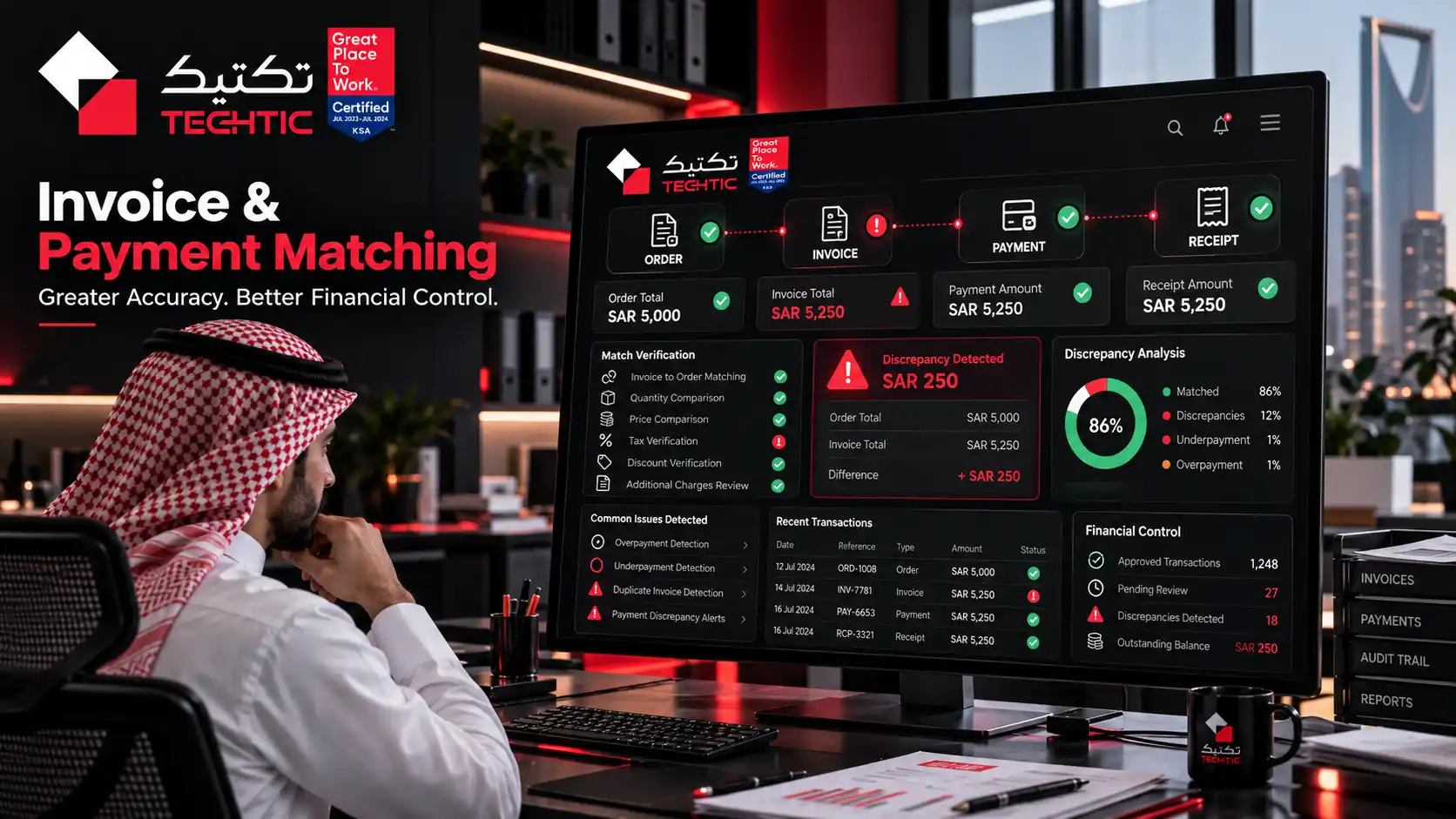
As the volume of financial transactions continues to grow, along with the increasing number of orders, invoices, and payments, reviewing every transaction and ensuring its accuracy is becoming a growing challenge for businesses.
Discrepancies may appear between an order value and an invoice amount, result from an incorrect tax or discount, or become visible when comparing the amount paid with the amount due.
This is where Invoice and Payment Matching plays an important role. By reviewing and comparing transaction details, businesses can verify financial accuracy, identify discrepancies, and strengthen control over invoicing and payment processes.
What Is Invoice and Payment Matching?
Invoice and Payment Matching is the process of reviewing and comparing data related to an order, invoice, payment, and financial receipt to ensure that all transaction details are consistent and that there are no unexplained discrepancies.
The matching process may include verifying:
- Total order value
- Invoice amount
- Products or services ordered
- Quantities and prices
- Taxes
- Discounts
- Additional charges
- Amount paid
- Financial receipts
- Outstanding or remaining balance
Through this review, businesses can identify discrepancies between recorded data before they affect the accuracy of financial records or lead to unnecessary losses.
Why Do Businesses Need Invoice and Payment Matching?
Businesses process a large number of orders, invoices, and payments every day. As transaction volumes increase, identifying every error through traditional manual review can become increasingly difficult.
Discrepancies may result from:
- Incorrect data entry
- Price differences between the order and invoice
- Differences between ordered and invoiced quantities
- Incorrect tax calculations
- Unauthorized or incorrectly applied discounts
- Overpayments or underpayments
- Duplicate invoices or payments
- Differences between invoice and receipt information
- Errors in recording financial transactions
Invoice and Payment Audit Services help businesses review transaction details more accurately and identify financial discrepancies more efficiently.
How Does Invoice and Payment Matching Work?
The matching process involves several stages designed to review a financial transaction from the initial order through to payment completion.
1. Reviewing Order Details
The process begins by reviewing the key order information, including products or services, quantities, prices, and any agreed discounts or financial terms.
These details serve as the primary reference when reviewing and matching the invoice.
2. Matching the Invoice to the Order
The invoice is reviewed against the original order to verify:
- Products or services
- Quantities
- Prices
- Order value
- Discounts
- Taxes
- Additional charges
This step helps identify differences between what was ordered and what was invoiced.
3. Reviewing Taxes
Taxes can significantly affect the final invoice amount.
The tax amount is therefore reviewed to ensure it has been calculated correctly and is consistent with the transaction value.
4. Verifying Discounts
When discounts, promotions, or agreed pricing are applied, they are reviewed to ensure they have been correctly reflected in the invoice.
The review may verify:
- Discount amount
- Eligibility for the discount
- Whether the discount has been applied more than once
- Whether the discount is correctly reflected in the final invoice total
5. Matching Payments
Once the invoice has been reviewed, the amount paid is compared with the amount due.
This helps identify:
- Underpayments
- Overpayments
- Payments not linked to invoices
- Differences between the invoiced and paid amounts
6. Reviewing Financial Receipts
Financial receipts are checked against invoice and payment information to help maintain a consistent record of the transaction.
What Discrepancies Can Be Identified Through Invoice Auditing?
Invoice and Payment Review can help identify several types of financial discrepancies, including:
| Discrepancy Type | Example |
|---|---|
| Price discrepancy | The invoice price differs from the order price. |
| Quantity discrepancy | The invoiced quantity differs from the ordered quantity. |
| Tax discrepancy | The calculated tax amount differs from the expected amount. |
| Discount discrepancy | An incorrect or unauthorized discount is applied. |
| Total discrepancy | The invoice total does not match the order value. |
| Payment discrepancy | The amount paid does not match the amount due. |
| Receipt discrepancy | Receipt details do not match the transaction. |
| Duplicate invoice | The same invoice is issued or recorded more than once. |
The Importance of Invoice and Payment Auditing for Businesses
The importance of Invoice and Payment Matching goes beyond identifying errors. It can also help improve financial efficiency and strengthen internal controls.
Reducing Financial Errors
Regular reviews help identify invoice and payment errors before they accumulate or become recurring issues.
Improving Financial Data Accuracy
When order, invoice, and payment data are properly matched, financial records become more accurate and consistent.
Reducing Incorrect Payments
Matching helps identify overpayments and underpayments and confirms that payments are linked to the correct transactions.
Strengthening Financial Controls
The auditing process provides an additional layer of review that helps businesses strengthen control over financial transactions and reduce errors.
Identifying Recurring Discrepancies
Reviewing a large volume of transactions can reveal recurring patterns, such as repeated differences in prices, quantities, or tax calculations.
What Is the Difference Between Invoice Auditing and Payment Matching?
Invoice Auditing and Payment Matching are closely connected, but each focuses on a different part of the review process.
Invoice Auditing focuses on verifying the accuracy of invoice data and ensuring that it corresponds with the order or agreed terms.
Payment Matching, on the other hand, focuses on confirming that the amount paid corresponds with the amount due and the related invoice.
When combined, both processes provide a more comprehensive review of the financial transaction cycle, from the initial order to invoicing and payment.
Matching Invoices with Orders and Purchase Orders
Invoice-to-Order Matching is an important step in financial auditing, particularly for businesses that manage large numbers of suppliers and purchase orders.
An order may be created for a specific value, while the final invoice may show a different amount due to changes in quantities, prices, fees, or taxes.
For example:
Order:
100 units × SAR 50 = SAR 5,000
Invoice:
105 units × SAR 50 = SAR 5,250
In this case, there is a discrepancy in quantity and invoice value that requires review before the transaction is approved.
Invoice-to-Order Matching helps identify such discrepancies and verify that the invoiced amount accurately reflects the original transaction details.
How Does Invoice Matching Improve Financial Efficiency?
Invoice and Payment Review can help reduce the time and effort required to review transactions, particularly when a business processes a large volume of invoices and orders.
Key benefits include:
- Faster transaction reviews
- Reduced reliance on manual review
- Early identification of discrepancies
- Improved record accuracy
- Better support for finance and accounting teams
- Stronger payment controls
- Reduced likelihood of recurring errors
- Greater visibility into financial data
When Does a Business Need Invoice and Payment Audit Services?
The need for Invoice and Payment Audit Services increases when a business has:
- A high volume of invoices
- A large number of daily orders
- Frequent purchasing activities
- A large supplier base
- Multiple financial transactions
- Payments across different channels
- A need to strengthen financial controls
- Challenges identifying discrepancies manually
In these situations, working with a specialized service can help organize the review process and identify discrepancies more efficiently.
Invoice and Payment Matching with Techtic
Techtic’s Invoice and Payment Matching service helps businesses review financial transactions and verify that invoices match order details and that payments have been processed accurately.
The service includes reviewing discrepancies between:
- Total order value
- Invoice amount
- Taxes
- Discounts
- Amount paid
- Financial receipts
Through this review, businesses can gain greater visibility into financial discrepancies and support greater accuracy across invoicing and payment processes.
Don’t just review the invoice. Verify the entire transaction.
Match the order. Review the invoice. Verify the payment. Identify the discrepancies.
Frequently Asked Questions About Invoice and Payment Matching
What is Invoice and Payment Matching?
It is the process of comparing order, invoice, payment, and financial receipt data to verify consistency and identify discrepancies.
Why is Invoice Matching important?
It helps businesses identify errors in prices, quantities, taxes, discounts, and payments while improving the accuracy of financial records.
What is the difference between Invoice Auditing and Payment Matching?
Invoice Auditing focuses on verifying the accuracy of an invoice and matching it with the related order, while Payment Matching focuses on confirming that the amount paid corresponds with the amount due.
What types of discrepancies can be identified?
The process can identify discrepancies in prices, quantities, taxes, discounts, totals, payments, and receipts, as well as duplicate invoices.
How can Invoice Audit Services help businesses?
They can help review transactions, identify discrepancies, improve data accuracy, and strengthen controls over invoices and payments.
Does Invoice Matching include reviewing taxes and discounts?
Yes. The matching process can include reviewing taxes, discounts, and additional charges to ensure they are correctly reflected in the final invoice amount.