
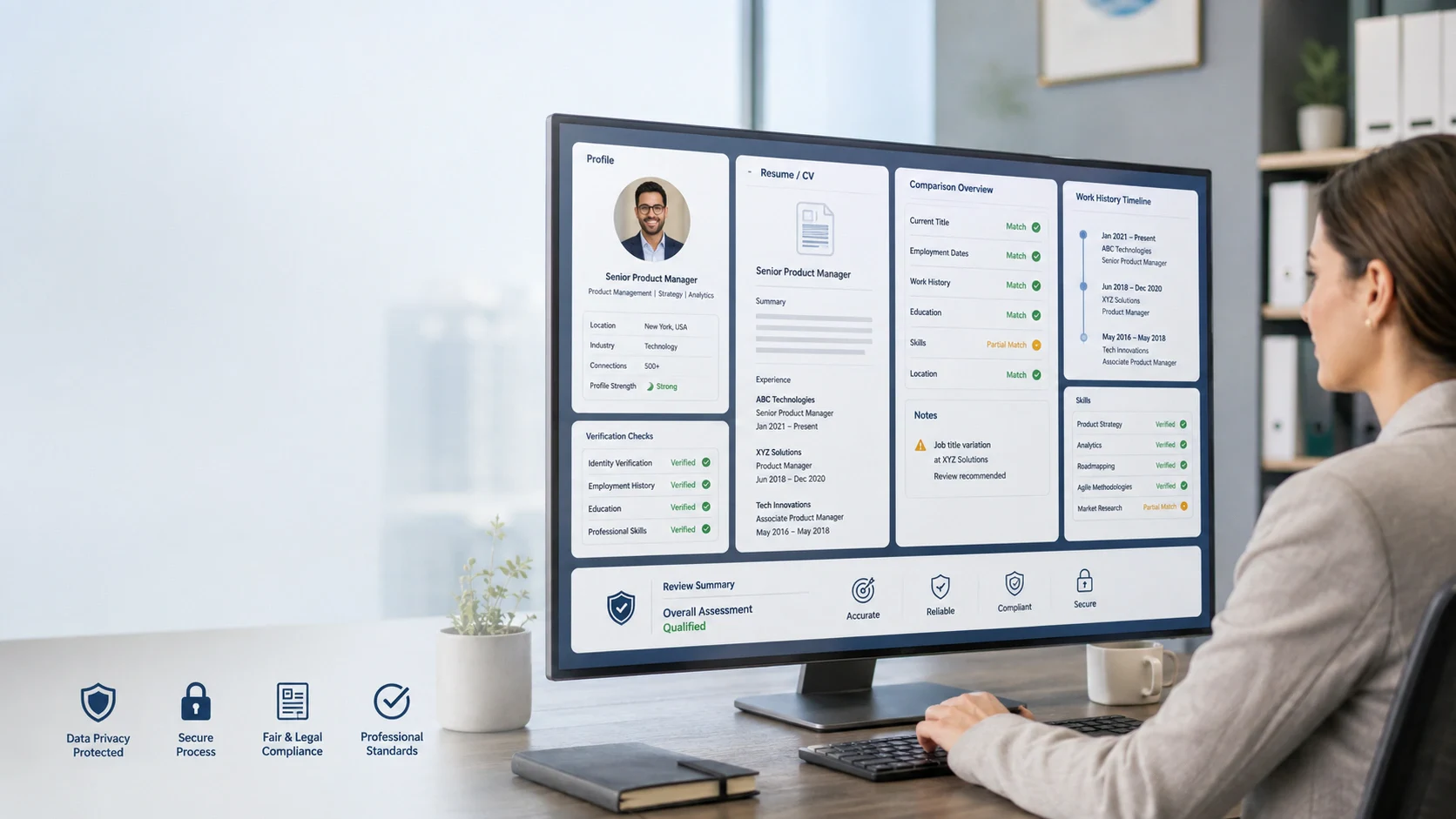
Social media screening has become an important part of candidate background verification, particularly for positions that require a high level of trust, responsibility, and professional integrity. This type of screening helps organizations review publicly available professional information, compare it with information provided in resumes and employment applications, and identify potential discrepancies while maintaining compliance with applicable privacy and employment regulations.
The purpose of social media screening is not to make judgments based on a candidate’s personal life, but to verify job-relevant information and identify indicators that may require further review.
What Is Social Media Screening?
Social media screening is a structured process of reviewing publicly available information across digital platforms, such as LinkedIn and other platforms where users have made their information publicly accessible.
The screening process may include:
- Reviewing professional profiles and publicly available information.
- Verifying job titles and employment history.
- Comparing employment dates and durations.
- Reviewing listed qualifications and professional skills.
- Identifying potential red flags related to job-relevant information.
- Detecting inconsistencies between available sources.
- Documenting findings in a structured and professional manner.
Why Do Companies Need Social Media Screening?
As recruitment becomes increasingly digital, professional online profiles can provide an additional source of information to support Background Checks and Employment Screening processes.
Social media screening can help organizations:
- Improve background verification accuracy
By comparing publicly available professional information with the information provided during recruitment. - Identify inconsistencies
Such as differences in job titles or employment periods between a resume and a professional profile. - Support hiring decisions
By providing additional job-relevant information for consideration. - Reduce the risk of inaccurate information
By identifying information that may require further verification through reliable sources. - Strengthen compliance processes
When screening is conducted according to clearly defined policies and applicable privacy and regulatory requirements.
Reviewing Professional Social Media Profiles
The process begins with reviewing publicly available professional information relevant to the candidate’s career history.
Key areas may include:
| Area Reviewed | What Is Verified | Example of an Indicator |
|---|---|---|
| Job Title | Whether the title matches the resume | Significant difference in job title |
| Employer | Whether previous employers match | Employer listed in the CV but not on the professional profile |
| Employment Dates | Start and end dates | Significant difference in employment duration |
| Professional Experience | Career progression and timeline | Unclear employment periods |
| Qualifications | Publicly stated professional qualifications | Difference in qualification or specialization |
| Skills | Relevance of listed skills to the role | Experience claims that cannot be supported by available information |
| Professional Profile | Consistency across professional sources | Conflicting professional information |
| Relevant Public Activity | Job-related public indicators | Content requiring review under company policy |
Evaluating Potential Red Flags
A red flag does not necessarily mean that a candidate has committed misconduct or is unsuitable for a position. Instead, it indicates that certain information may require additional verification or review.
Potential indicators may include:
- Significant differences in employment dates.
- Conflicting job titles.
- Professional experience claims that do not align with publicly available information.
- Unexplained changes in career history.
- Inconsistent information across multiple sources.
- Professional information that cannot be readily verified.
These indicators should be assessed carefully and should not be treated as conclusive evidence without verification from a reliable source.
Identifying Inconsistencies in Candidate Information
One of the key benefits of Social Media Background Checks is the ability to compare publicly available information with information provided by the candidate.
For example, if a resume states that a candidate held a management position for five years, while their professional profile shows a substantially different period, this may justify additional
Employment Verification.
Examples of Potential Inconsistencies
| Candidate-Provided Information | Publicly Available Information | Recommended Action |
|---|---|---|
| Project Manager for 5 years | Different employment period shown | Verify employment history |
| Specific academic qualification | Different academic information available | Conduct Academic Verification |
| Employment with a specific company | Position is not reflected in the profile | Request additional verification |
| Management-level job title | Different title appears | Compare responsibilities and experience |
| Continuous employment history | Unexplained gap appears | Review employment timeline |
Social Media Screening and Employment Verification
Social media screening can be combined with Employment Background Checks to develop a more complete understanding of a candidate’s professional history.
The verification process may include:
- Confirming previous employer names.
- Confirming job titles.
- Verifying employment start and end dates.
- Reviewing roles and responsibilities when appropriate.
- Conducting Reference Checks according to company policy.
- Verifying the reason for leaving when legally permitted and relevant to the verification process.
In this context, social media should be considered a supporting source of information rather than a replacement for official employment verification or direct verification with credential-issuing institutions.
Privacy and Compliance Considerations
Social Media Screening should be conducted according to a clear and consistent policy that protects candidate privacy and ensures that only job-relevant information is considered.
Organizations should consider:
- Using publicly available information only.
- Applying consistent screening criteria to all candidates.
- Documenting screening results professionally.
- Avoiding sensitive or personal information that is unrelated to the position.
- Verifying potential red flags before making decisions.
- Complying with applicable local regulations and data protection requirements.
Conclusion
Social Media Screening is more than simply searching for information about a candidate. It is a structured process for reviewing professional information, comparing it with other sources, and identifying inconsistencies or indicators that may require additional verification.
When combined with services such as Employment Verification, Reference Checks, and Background Checks, social media screening can help organizations build a more structured and reliable candidate verification process while maintaining privacy and compliance principles.